

Introduction
The AI revolution in security operations is here, but the gap between marketing promises and ground truth is wider than most vendors would like to admit today. After three decades building security software and working directly with SOC teams implementing AI technologies, I've seen what actually works—and what doesn't.
Today, AI in the Security Operations Center (SOC) is awash with buzzwords. You hear about revolutionizing cybersecurity, autonomous everything, and an end to analyst toil. Some of that is on point; a lot of it is overly optimistic for where we stand today. My focus, and what I see delivering real value on the ground, is how AI genuinely helps us reduce risk. Everything else, while important, is a supporting actor to that primary goal.
Augmentation: The real promise of AI for SOC in 2025
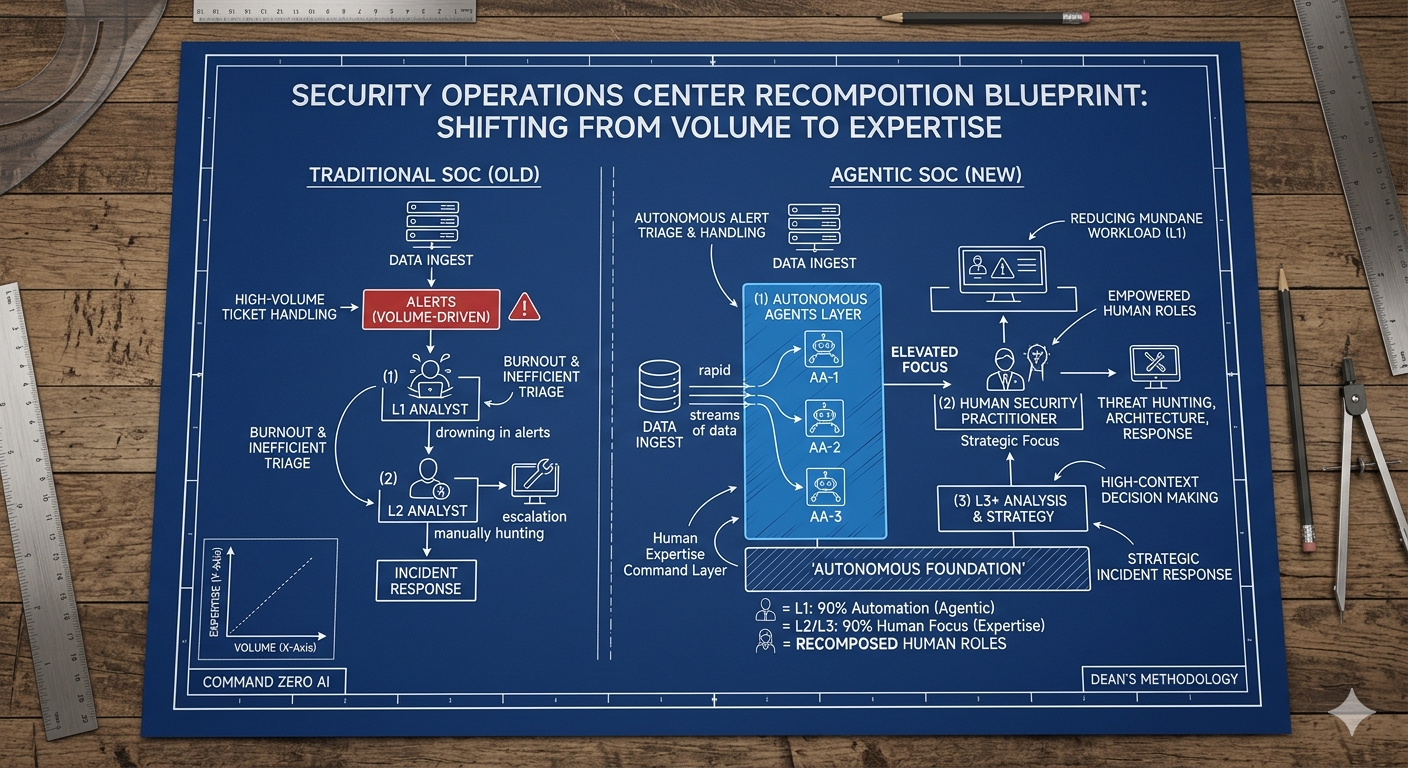
AI's true value for the SOC lies in capability augmentation, not replacement. Most SOC analysts are SMEs in one or two narrow areas—typically endpoint security. AI rapidly expands their expertise across unfamiliar data sources while maintaining the same investigative outcomes. This means you can get everyone off the bench and into the game.
LLMs excel at removing investigative drudgery: log correlation, data extrapolation, and baseline analysis. This keeps analysts cognitively focused instead of context-switching between mundane tasks. AI also transforms report generation, enabling analysts to articulate issues to multiple stakeholders and dialogue with data sources without logging into dozens of different consoles.
Distinguishing marketing vs real impact
Security marketing consistently leans ahead of functionality, creating unrealistic expectations or jadedness. The most problematic messaging focuses exclusively on "time to resolve" and "replacing tier-1 analysts."
Time-saved metrics are valuable—security products are drowning teams in alerts, and alert fatigue is real. But optimizing purely for speed creates dangerous tunnel vision. When analysts are on the clock, expediency becomes everything, leading to narrow investigative scope and missed threats.
The messaging should emphasize thoroughness and skill development. Risk reduction is the ultimate goal of both SOCs and CISO organizations. Making the same mistake faster benefits no one. We haven't proven that AI judgment surpasses tier-1 analyst's judgment—but we have proven that the combination is powerful.
What's actually working in 2025
Real adoption success comes from specific, proven use cases:
- Unplaybooked Investigations: Large language models excel as force multipliers for investigations without existing playbooks. This is where tier-2+ analysts struggle most—getting from A to Z without previous instructions. LLMs enable these investigations with higher fidelity and sensible timeframes.
- Reasoning Through Alerts: The most effective approach has LLMs reason through investigations with analysts proving them out afterward. This combines the model's analytical power with human business context and case history knowledge.
- Comprehensive Reporting: Every investigation should produce a well-articulated, stakeholder-relevant document. LLMs make this standard practice instead of an exception reserved for full-blown IR incidents.
The state of adoption
Early challenges
Technology quality alone doesn't drive adoption. SOCs are complex environments constrained by existing technology investments, staff training, and budget cycles. Any solution must integrate with tens of millions in existing infrastructure—enterprises won't turf their entire SOC for relatively new automation platforms.
Successful adoption happens when organizations understand they must slot AI into existing workflows. Greenfield SOC rebuilds are rare. Most customers need gradual deployment and implementation projects, not overnight switches.
The commitment requires measurable, provable outcomes. Teams need retraining on new platforms, and results must be ruthlessly measured throughout the process.
The road to 2026-2027
By end of 2025, adoption will become mainstream as projects launch and platforms deploy. Real-world contact with production environments will mature these technologies rapidly. Most vendors in this space are relatively new—battle testing will separate effective solutions from enthusiastic marketing.
2026 will see genuine environmental transformation. By 2027-2028, AI for SOC will be standard practice.
The AGI transformation
AGI will enable close to machine-speed response and investigations—critical as both defenders and attackers gain access to the same innovations. The balance typically favors attackers initially.
True environmental defense requires AI embedded natively across all systems: HRMS platforms, email systems, every business application. Agentic technology will coordinate between systems to investigate, solve, remediate, and act upon security events in near real-time.
The SOC becomes an orchestrator, tuner, and arbiter rather than having humans involved in every investigation. This isn't controversial—it's inevitable. What we have now clearly isn't working, and we can't scale human involvement to match threat volume.
Moving beyond time-to-resolution
The industry obsesses over speed metrics while missing the bigger picture. Current SOC practices incentivize analysts to move faster without focusing on quality or scope expansion. We're pushing them toward smaller scopes to run faster, which doesn't deliver optimal results.
AI should relieve analysts from high-speed chases while enabling thorough investigations. The goal isn't just faster responses—it's better outcomes through comprehensive analysis powered by augmented capabilities.
Navigating a historic inflection point
This represents the biggest sea change in cybersecurity history. Network IPS/IDS, modern firewalls, EDR—none compare to the transformation we're witnessing. Those innovations aren't within visual distance of what's happening now.
We're entering a wild ride over the next three years. Organizations that understand AI as an augmentation tool rather than a replacement solution—and implement it thoughtfully within existing workflows—will emerge significantly stronger.
The key is moving beyond marketing hype to focus on proven capabilities: investigation augmentation, comprehensive reporting, and skill development. Risk reduction through better outcomes, not just faster ones.
Book a demo today to see how Command Zero can incorporate LLMs into your SOC flows today.

Subscribe security updates
Run Better Investigations.
At Every Tier.